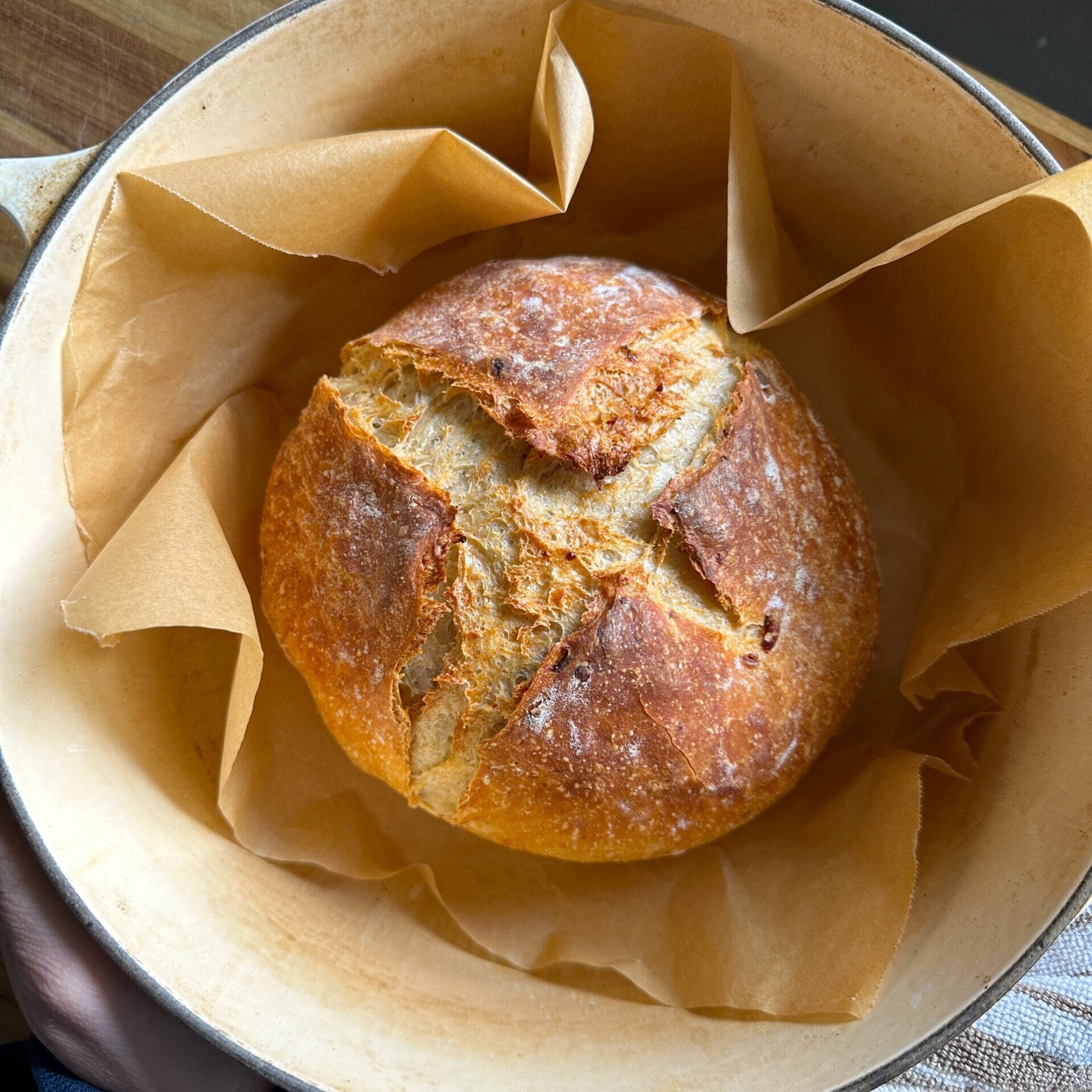
We eat a lot of bread in my house (toast! grilled cheese! every time we make pasta!) which is why I’ve been craving a homemade version with a little more protein. But because I’m not really a from-scratch bread person (my sourdough journey was very shortlived), I decided to start with a no-knead formula — aka the easiest type of bread there is.
After some trial and error, I found great success adapting King Arthur Baking Company’s no-knead bread recipe by swapping cottage cheese for some of the water. I also adjusted the method to bake the dough in a preheated Dutch oven, which gives the loaf an extra crispy crust and eliminates the need for a water bath.
The result is a cross between a crusty artisan loaf and a soft sandwich bread: crisp on the outside, tender on the inside, sturdy enough for sandwiches but still incredible toasted. Plus, the loaf stays soft at room temperature for several days. (After that, I recommend freezing individual slices).
Each slice packs 8 grams of protein, which, for bread, is kind of huge. I can’t wait to hear what you think.
*timing heads up: After rising at room temperature for 2 hours, the dough needs to chill in the fridge for another 2 hours or overnight, and then rest again at room temp. for 1 to 2 hours.



Ingredients
- 1 cup low-fat or full-fat cottage cheese (225g), drained if watery
- 1 cup lukewarm water (~105°F)
- 3 3/4 cups all-purpose flour (450g)
- 1 (1/4-ounce) packet active dry yeast (2 1/4 teaspoons)
- 1 1/2 teaspoons kosher salt
Instructions
- Add the cottage cheese to a glass measuring cup and use an immersion blender to blend until mostly smooth. (Alternatively, you can blend in a blender or mini food processor, then transfer the cottage cheese to a large microwave-safe bowl).
- Microwave the cottage cheese, stirring after 30 seconds, until slightly warm to the touch but not scalding hot, 50 to 55 seconds total. (If you’re using a thermometer, it should be about 105°F).
- Transfer the cottage cheese to a large bowl, if necessary. Add the lukewarm water and whisk to combine. Add the flour, yeast, and salt, and stir with a wooden spoon or rubber spatula until a shaggy dough forms. Use your hands to knead it a few times, just until it comes together into a ball (it will be very sticky).
- Cover the bowl with plastic wrap or a clean kitchen towel and let rise at room temperature for 2 hours. Transfer to the refrigerator and chill for at least 2 hours and up to 2 days.
- Remove the dough from the refrigerator and take off the plastic wrap (it’s fine if the top has crusted slightly). Invert the dough onto a lightly floured surface so the bottom (the part that was touching the bowl) is facing up. Gently pull each side up and into the center.
- Flip the dough so the seam side is down. Using your hands, gently rotate and tuck the dough under itself to form a tight, smooth ball. Transfer to a piece of parchment paper, dust with flour, and loosely drape with greased plastic wrap.
- Let rise at room temperature until the dough springs back slowly when you press a finger into the surface, 1 to 2 hours depending on the temperature of your kitchen. It won’t double in size but will spread slightly.
- About 30 minutes before baking, place a large (4-to-6 quart) lidded Dutch oven on the center oven rack and preheat the oven to 450°F.
- Using a sharp knife, slash the top of the dough in a cross pattern. After 30 minutes, carefully remove the hot Dutch oven from the oven, lift the dough (still on the parchment) into the pot, and cover with the lid. Bake for 25 to 30 minutes or until crusty and lightly golden brown. Remove the lid and continue baking until deeply brown all over, 5 to 10 minutes more.
- Carefully lift the bread out of the Dutch oven and transfer to a cooling rack (discard the parchment). Let cool completely before slicing, at least 1 hour.